Total Pageviews

Saturday, June 26, 2010

ANCHORS AWEIGH!!!


Anchors aweigh! This is what usually heard during anchor operation when the ship’s anchor had already cleared the seabed and after which the vessel start to move away after staying for a certain period of time in a place where it was safely anchored. Normally, anchor operation is a task initiated by a deck officer assisted by ratings on duty with proper coordination in the bridge headed by the Captain.
As the word implies “Anchors Aweigh” means not only about to sail away but it connotes different meanings or understanding. Bad and good impressions go with the word. First, precedence of good impression is when the Captain himself is true to himself and broadminded. He takes full control of himself and his subordinates with kindness and respect.
And that’s what Captain Jessie Juanico did during the time when I was one of his ratings who witnessed and approved his leadership aboard LPG Tanker Minorca. He put in high regard the interests of his men and the ship itself. Thus the men anchored their trust and confidence to Captain Juanico and together they hollered “Anchors Aweigh” and sailed in unison.
Like in any other story, good times come and go, and so with seafaring. The Captain signed-off after his contract ended. Showing the quality of an officer and a gentleman, Captain Jessie Juanico turned-over his command to the incoming Captain, also from the Philippines.
At first the situation remained normal until suddenly, at the snap of a finger the ship’s aura turned dark. The precedence of bad impression ultimately filled the ship’s atmosphere. The new Captain intentionally has shown his arrogance and egotistic behavior of exaggerated sense of importance and superiority to all his subordinates. Worse, he made it hard for all crews to suffer without fresh water and letting them to use yellowish/rusty water for their daily needs. And shore leave was rare, prompting subordinates to express disapproval.
The Captain’s brand of leadership and doctrine lacks propriety but then seafaring is like any other military establishment where the chain of command always being followed, even if wrongs are part of it. And when everybody hears “Anchors Aweigh” all are up and about to sail with the Master and no questions ask.
The photo shows Captain Jessie Juanico supervises fire drill at the poop deck.

Wednesday, June 23, 2010

VIETNAMESE BOAT TRADERS EARN DOLLARS FROM FOREIGN SHIPS


During the end of the Vietnam War in the 70’s a big number of people living in the south of the country fled to escape from the victorious Red Army of the late Ho Chi Minh of the North. The then intense and dangerous situation had prompted the southerners to leave their beloved country using boats made of wood which the fleeing men and women, young and old were later called as the “Vietnamese Boat People.”

The “Vietnamese Boat People” chose to leave the country not because the Americans were defeated, as confided to me by Mr. Treth Theat Hao, a shipping agent from Quy Nhon City. According to him, the “Vietnamese Boat People” fled because they anticipated reprisal and death from the conquering northern brothers.

The very long years of sufferings of the “Vietnamese Boat People” was one of the history’s worst kinds of human degradation or humiliation recorded in the 20th century. And after that humiliating part descended upon the “Vietnamese Boat People” in the “cold war era,” a new generation of “Vietnamese Boat People” resurfaced but not as refugees but they are the “Vietnamese Boat Traders.”

The so called “Vietnamese Boat Traders” hawks their merchandize to both locals and crews of foreign vessels calling port mostly in Saigon a.k.a. Ho Chi Minh and nearby cities. The floating market or boat traders sell different kinds of goods from fruits, vegetables, wine with preserved curled snake inside of the bottle, drinks, souvenir items, apparels, shoes or sneakers and many other which have prices lower than in the department stores.

The “Vietnamese Boat Traders” are usually smiling young women in their colorful dress and paddy hat. Every time foreign ships approached ports or jetties, they scramble to get alongside the ship and immediately offer their goods to excited crews and officers. These young women are beguile and attracts attention so easily that ship personnel buy more goods in DOLLARS of course.

The “Vietnamese Boat Traders” has become a burgeoning class of Vietnamese society considerably because they earn DOLLARS in their own backyard without going the usual route of working abroad.
Search Amazon.com for lg chocolate touchSearch Amazon.com CellPhones for lg chocolate touch

Monday, June 21, 2010

SAND QUARRYING THREATENS VIETANAM’S PICTURESQUE LANDSCAPE

Vietnam’s Mekong River crisscrossing the country’s picturesque landscape is so important that it is not only serves the locals for its fishing industry but it is where shipping activities makes the river busy all year round. Foreign and local ships use the many branches of the river to travel inland specifically Ho Chi Minh (formerly Saigon) the biggest and the most vibrant city in Vietnam.

Before the rivers streaming south of the country looked placid and devoid of life. Normally locals ply their trade in their usual get-up – the common Vietnamese dress with matching conical hat or paddy hat. Their daily routine is repeated in as much as they could remember under the communist style democracy.

But after decades of underdevelopment Vietnam pole-vaulted into the 21st century and the country’s rivers, the primary access to the outside world was finally opened. The rivers’ “gate of development” was practically wide open that merchant shipping started to grow fast and brought in progress to the Vietnamese people.

Unfortunately, Vietnam which is trying to muster the threshold of maturity - economically and politically speaking - misread or did not pay attention to the other side of progress and development. The government which is too busy counting exports is seemingly unaware of their responsibility to protect their rivers from commercial destruction.

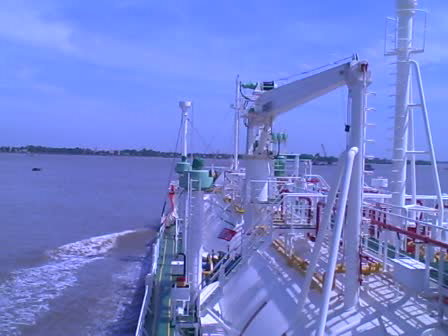
In our repeated sorties to deliver LPG cargo to Ho Chi Minh and neighboring cities like Can Tho, Dong Nai and other city, I came to witness the wanton destruction of the rivers we pass-by. Dredging equipments and boat-haulers continuously do their thing extracting sands near river banks and right on the middle of the river where big foreign ships travels.

Locals living near the river channels complain of soil erosion and they are afraid of losing their lands once the river completely gobbles-up the affected areas. According to a worker of an LPG depot, sands extracted were being exported to Singapore for construction purposes.


Get cash from your website. Sign up as affiliate.

Friday, June 18, 2010

THE DIRTY BUSINESS OF CARGO OPERATION EXPOSED


In my nine months (April 2009-Jan 2010) of working aboard a Singapore Flag LPG Tanker vessel I came to know first hand the intricacy or the complex nature of ship operations. I thought ship operation is only about loading and unloading cargo from one port to another and from a ship to another. I thought that cargo operations were done expeditiously and smoothly. But it wasn’t.

I came to know that cargo operations in general are quite complex or intricate because deceit or dishonest practices go hand in hand before, during and after commencing cargo transfer operations. Cargo operations normally commenced after clearing all papers reviewed and signed by the Captain, Chief Officer, Chief Engineer and shore personnel

But usually disagreements, protest, counter protest come into view during and after cargo transfer operations. In most cases the involve party argue about the actual number of tons of cargo transferred. In ship to port or vice versa cargo operations, the problem is minimized to a low level and ultimately resolved immediately.

But not with ship to ship cargo operations because the receiving party is always the one shortchanged of deficient cargo transferred. Here, protest and counter protest normally happened. Tons of cargo ends on the hands of deceiving party.

The worst violator in cargo operations are the bunker vessels. They use techniques to deceive or cheat and manipulate cargo transfer. Their techniques, honed to perfection, are pretty much applied during bunkering. They pumped bunker fuel mixed with full of oxygen to reached the agreed tons but actually falls flat when measured using sounding tape.

Crews of bunker vessels are stern and dirty looking men (literally indeed), shaped by their being dishonest. No wonder that they are easily agitated when confronted regarding deficient bunker fuel transferred. In some cases officers, particularly Chief Engineer unwittingly colludes with the bunker personnel in exchange for money. Bunker vessels earn millions of dollars through tricks and deceit. Singapore is the place where bunkering operations thrives and keeps in business all year round.


Thursday, June 17, 2010

20Dollars2Surf - Earn 10% on 10 referral levels!

20Dollars2Surf - Earn 10% on 10 referral levels!
Super PTC Downline Builder!&U-Get NAME$ & EMAIL$!
ALL-YOUR-PTC Downline Builders IN ONE PLACE!!

THE CONTINUING PROBLEM OF HUMAN TRAFFICKING

A latest report on human trafficking released by the United States two days ago showed that the rate of occurrence of human trafficking have gone up in years. In spite of warnings from the US to all countries that have high incidence of human smuggling, the problem persisted owing to the fact that the countries identified in the said report were known to have a weak legal system and corrupt airport and immigration officials and other concerned authorities who tolerates the problem.

The Philippines and Vietnam which was on the top list of the US report failed to stamp-out human trafficking even though warnings and notice of communication had been continuously relayed by the US. In the Philippines human smuggling is a daily routine for scheming government officials in cahoots with progenitor of evil.

Most of the people being trafficked involved young women. Worst, these people ends in the Middle East, Malaysia and Singapore and other countries. The term modern slavery applies to these hapless people. They work in brothels and known hotels as masseuse cum sex partners, household slaves and work as prostitutes in well known parks of the host country.

In Singapore, many Filipino women recruited as tourists works as prostitutes catering to seafarers and other “seeker of flesh.” In Malaysia, Vietnamese and Filipinas work in prostitution dens and hotels providing sexual pleasure to patrons.

I honestly hurt and feel sadness when I was informed by my fellow crew member that Filipinas in Singapore ply their trade openly in the “Dragon City.” Shore leave is a must in Singapore because the country offers everything one could dream of. The same with Malaysia; young Vietnamese and Filipino women is a fixture in the country’s sex trade. But the thing is, these people are victims of human trafficking and the root cause is poverty, unemployment, illiteracy and abuse inflicted upon them by the environment they belong.

Wednesday, June 16, 2010

FISHING ON DECK

http://www.linkbucks.com/referral/255202
 Shore leave is not only the one that keep seafarers spend their free time. Fishing on deck is also part of their activity during the time when the ship is anchored off the berthing area. Fishing actually relaxes the mind and body after rendering four hours of duty. Excitement and joy filled the poop deck every time fish is pulled out of the water using hook attached to a string.

During daytime fishing is not easy to do unless one has patience. But night time is more exciting because not only fish is being caught but various sizes of squid which is more than attracted to the ship’s lights. Squids and fish playfully swims and flips right on the spot of light that beams through the water. Catching these sea creatures right on the spot is a delight to sailors because its fresh meat gives tasteful eating binge accompanied with cool beer on the table.